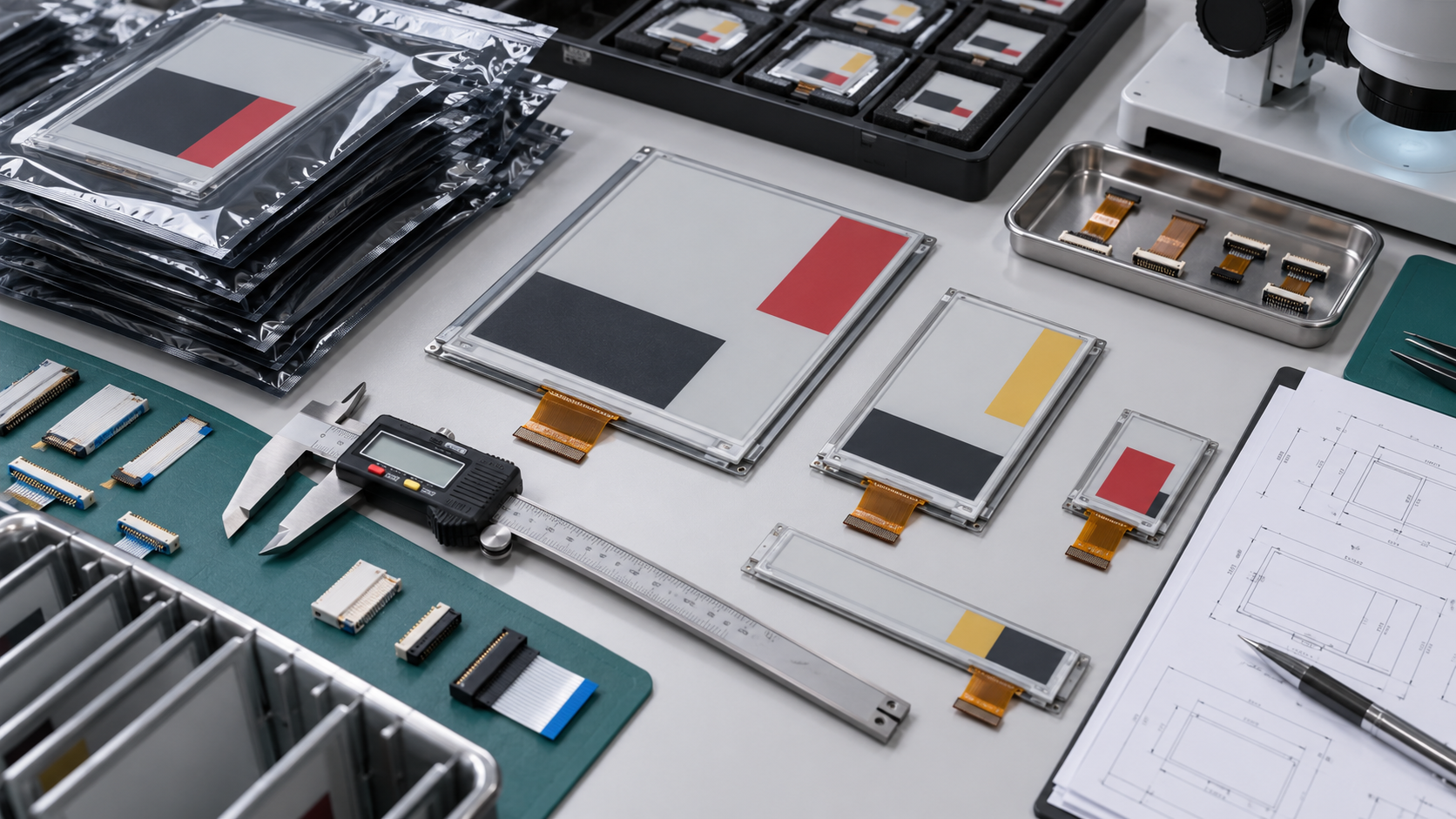
Buying e-paper displays in volume looks simple when the comparison is reduced to size, color and unit price. In production, the display is only one part of a system that includes the controller, waveform, power sequence, connector, enclosure, firmware, content pipeline and manufacturing process. A good sourcing decision aligns all of them before the purchase order becomes difficult to change.
01Write the application brief before requesting a quote
Begin with the product, not the panel. Define viewing distance, ambient light, operating temperature, update frequency, expected service life and the information that must be shown. Clarify whether the display will be indoors, exposed to direct sun, installed behind a cover lens, used in refrigerated space or carried as a portable device.
These conditions influence the choice between monochrome, three-color and four-color technology. They also affect enclosure sealing, optical expectations, refresh strategy and testing. Suppliers can make better recommendations when the request describes the operating environment instead of only asking for a diagonal size.

02Confirm the entire electrical interface
Request the active area, outline dimensions, resolution, pixel pitch, connector specification, pin definition and recommended power sequence. Confirm the controller or driver IC, supported waveform, full and partial refresh behavior, update time, current profile and temperature requirements.
Two panels with similar dimensions are not automatically interchangeable. A connector can face the opposite direction, a flex cable can be shorter, or a waveform revision can require different firmware. Ask for controlled drawings and revision identifiers so mechanical and electrical teams are working from the same source.
03Validate samples with production-like content
A sample should be tested with the images and layouts the product will actually display. Check small text, barcodes, QR codes, photographs, saturated blocks and repeated refresh cycles. Observe ghosting, edge quality, color consistency and behavior at the planned temperature limits.
Engineering samples should be mounted in an enclosure that resembles the final product. Pressure, uneven support or an optical cover can change the result even when the bare display looked acceptable on a bench.
04Compare total program cost, not only unit price
The landed display price is one line in a larger model. Include samples, driver boards, tooling, custom flex cables, certification, packaging, inspection, freight, duties, expected yield and integration time. A cheaper panel may require additional hardware or engineering effort that removes the apparent saving.
Minimum order quantity also needs context. Ask whether it applies to the panel, a custom print, enclosure color, packaging or the complete SKU. Separating standard and customized elements can sometimes improve flexibility.
05Turn quality expectations into measurable criteria
Agree on what counts as acceptable before mass production. Useful criteria may cover cosmetic defects, active-area marks, pixel behavior, connector condition, refresh completion, color variation, dimensions and packaging damage. Define the inspection method, sample size and escalation path for a failed lot.
A perfect hand-selected sample does not prove process stability. Ask how incoming materials are controlled, how finished displays are tested and how batches are traced. Consistency across shipments is more valuable than a single exceptional unit.
06Plan customization and lead time together
Custom housings, printed borders, firmware, connectors, packaging or unusual sizes can change engineering time, tooling cost and minimum quantities. Build a schedule that includes specification confirmation, sample manufacture, validation, corrective rounds, pilot production and mass production.
Do not treat sample approval as an informal message. Record the approved hardware revision, display lot, firmware, artwork and test result so the production reference is unambiguous.
07Ask about documentation and lifecycle support
Long-term products need stable access to datasheets, drawings, reference code and change notifications. Confirm how the supplier communicates component revisions, last-time buys and replacement options. If the design will ship for several years, discuss forecast visibility and buffer strategy before demand becomes urgent.
08Evaluate engineering communication
Fast, specific answers during the sample phase are an early indicator of support quality. A supplier should be able to explain trade-offs, identify incompatible assumptions and provide realistic delivery information. The most useful partner is not simply the one with the lowest quote; it is the one that helps the project reach repeatable production with fewer surprises.
09A sensible path to volume
Move through requirements, samples, integration testing, pilot production and documented approval. Each stage should remove a different risk. When the technical interface, quality criteria and commercial plan are all clear, volume purchasing becomes a controlled manufacturing decision rather than a bet on a promising sample.